
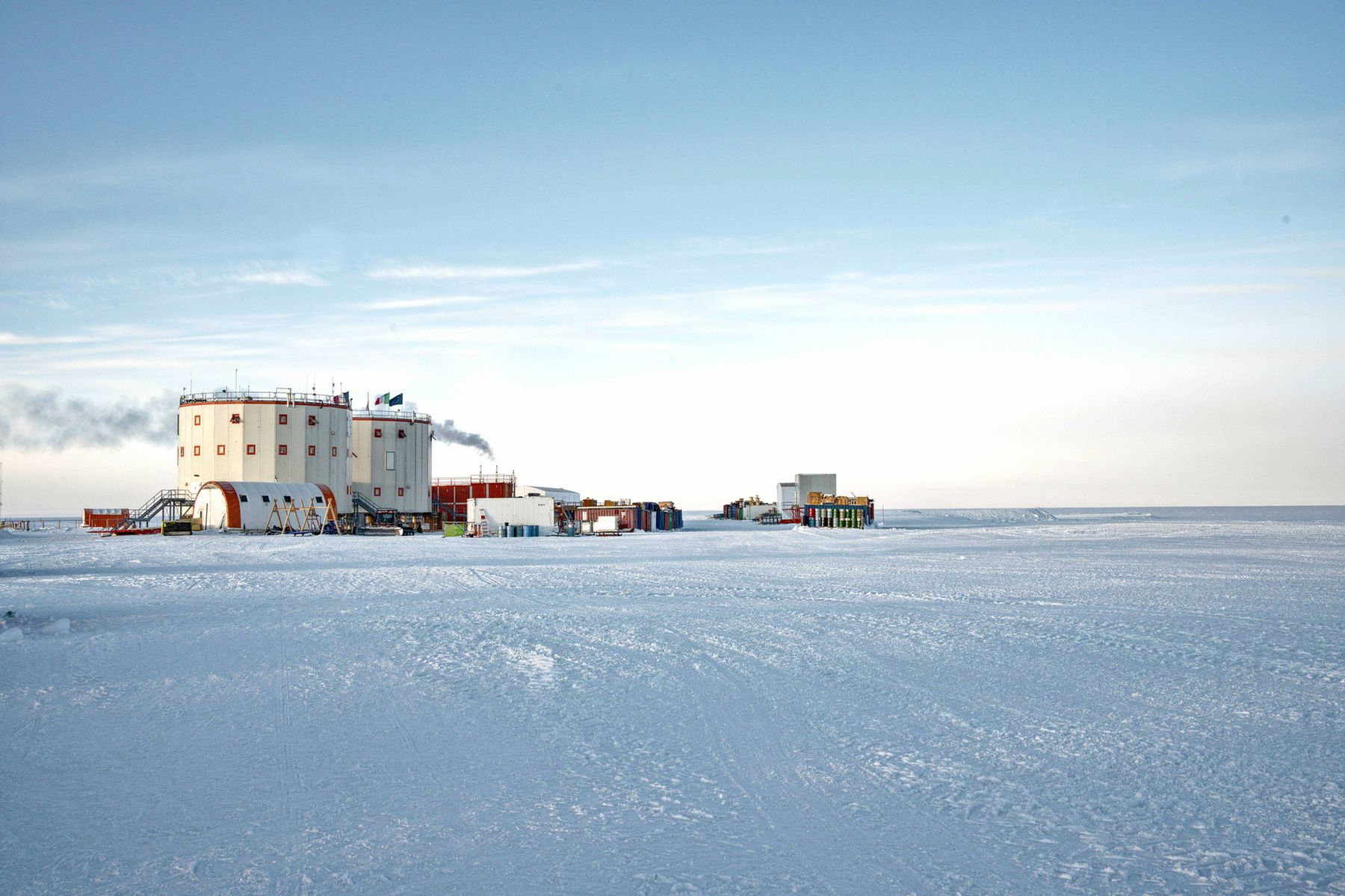
Concordia station is jointly funded, staffed and operated by Italy (National Antarctic Research Program - PNRA) and France (French Polar Institute Paul-Emile Victor - IPEV)
Location
Concordia station is located at Dôme C, on the high East Antarctic plateau. The site is one of the coldest and among the most remote places on Earth. Among the permanent stations in Antarctica, only 3 are located inland the continent (Amundsen-Scott, Vostok and Concordia). The closest stations are Dumont d’Urville and Mario Zucchelli.
Nearest settlement: 3780 (3780 km)
History
The idea of constructing a European permanent research station in the heart of Antarctica, with an environment particularly hostile for humans, sprang up when the site at Dome C was revealed to be especially favourable for deep ice coring and astronomy. This scientific challenge is accompanied by another, parallel adventure: the design and construction of a modern station, capable of yielding new scientific knowledge concerning not only Antarctica, but also concerning the whole our planet and beyond, the Universe. The Institut Polaire Francais Paul Emile Victor (IPEV) and the Programma Nazionale di Ricerche in Antartide (PNRA) have therefore pooled their skills and know-how, resources and combined operations to develop this new station between 1999 and 2005. Concordia has been continuously occupied since that time.
Research
The research projects implemented at Concordia are linked to many subjects involving societal concerns, such as climate change, the role of greenhouse gases or aerosols in past and present trends or the hole in the ozone layer. Beside the European Project for Ice Coring in Antarctica (EPICA), which was completed in December 2004 and extended the record of climate variability to around 800 000 years BP, Concordia remains an active site for glaciology. Dome C also offers an exceptional environment for astronomical observations and provides good conditions for calibration and validation of sensors embarked on polar orbit satellites. Observatories in seismology, geomagnetism, or Earth-Sun interactions are present. Concordia station itself is also considered as an excellent Earth-based analogue for orbital space stations or Mars-bound vessels and projects in collaboration with the European Space Agency (ESA) are implemented.
Biodiversity
Dome C is 1100 km from the coast at a height of 3233m a.s.l., surrounded by thousands of kilometers of solid ice. Temperatures hardly rise above -25°C in summer and can fall below -80°C in winter with record of -84.6°C reached in 2010. As a consequence, there is no fauna and no flora.
Human Presence
The station is suitable for 14 persons winter residents to live in, completely isolated from the rest of the world for 9 months in the year. Up to 70 people can work at the station in summer, using the nearby “summer camp”.
Climate
Scientific Facilities
Equipment
No basic scientific equipment. Each project should bring its own necessary scientific equipment.
Services
A scientific engineer (electronician) is appointed in winter for monitoring and maintenance of automated programs.
Access
Resupply of the station is ensured in summer by the traverse from Dumont d’Urville whereas personnel are brought over by air, from the Italian base Mario Zucchelli or from Dumont d’Urville. The vessel L'Astrolabe also forms part of the supply chain from Australia to Dumont d'Urville.
Polardex assistant
Sign in to ask about polar stations, vessels, aircraft and planned expeditions.
Sign in